
Media Contact
Laura Deupree
Senior Director, Marketing and Communications
Andrew Young School of Policy Studies
[email protected]
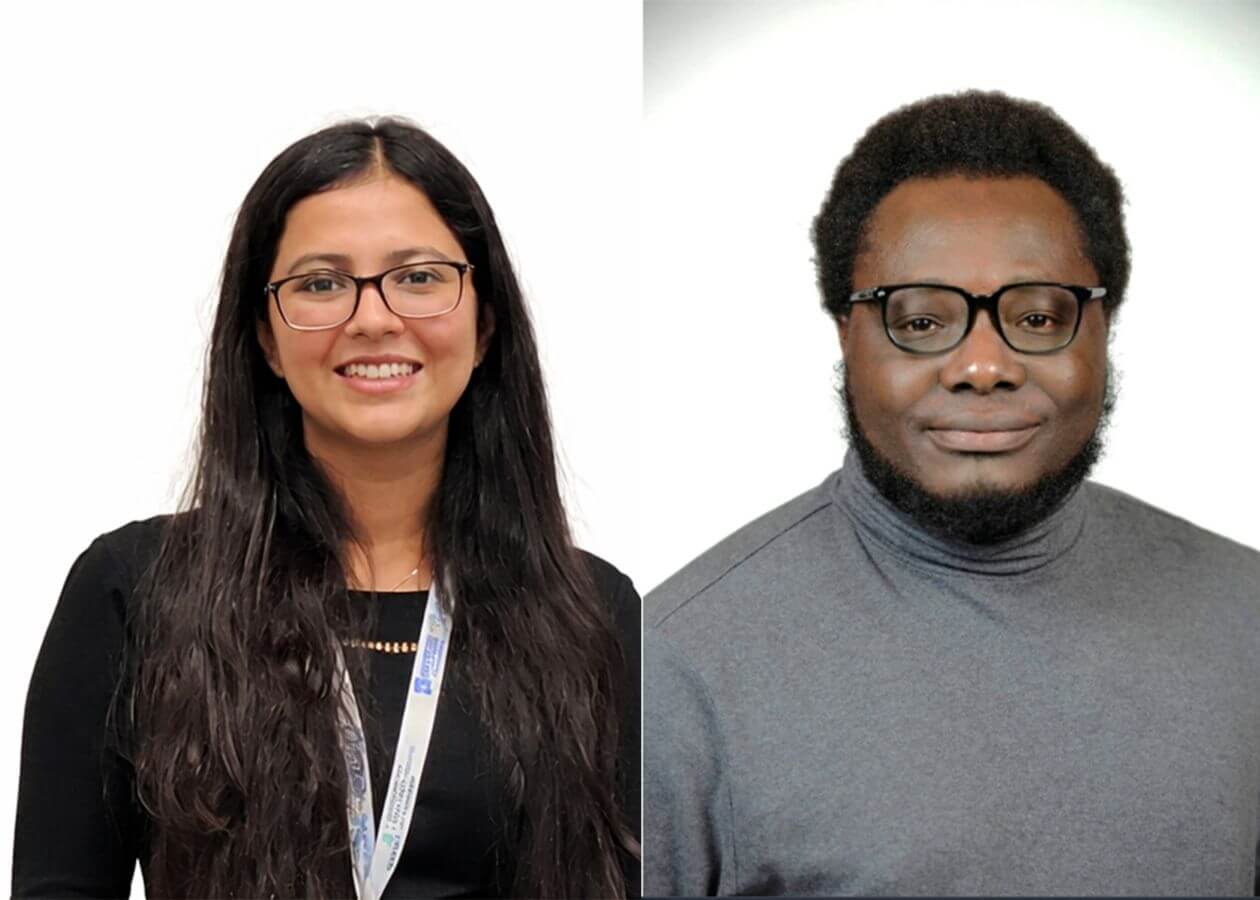
ATLANTA — For economists Raka Datta and Godwin Aipoh, research starts with questions about people: What happens when access to alcohol changes? Can medical drones improve maternal and child health? How do policies shape health and well-being?
Though the Georgia State University Ph.D. candidates approach these types of questions through different areas of economics, both will gain a broader platform for their research and professional development as 2026 recipients of the Association for Public Policy Analysis & Management’s (APPAM) Excellence, Equity and Inclusion Fellowship.
The fellowship will give the Andrew Young School of Policy Studies students opportunities to expand their professional networks, discuss their research and connect with researchers across public policy fields.
Research With Real-World Stakes
Aipoh’s interest in public policy grew from seeing gaps between institutions and the people they were intended to serve.
“I saw it in healthcare systems that did not reach rural communities, in educational institutions that produced talent the economy could not absorb, in the gap between what government promised and what people actually experienced,” he said.
An applied microeconomist whose primary field is health economics, Aipoh also has interests in development and public economics. His research examines how policies, programs and technologies affect health and well-being in the United States and Sub-Saharan Africa.
One of Aipoh’s current research projects examines whether drone delivery of medical supplies improved maternal healthcare use and child health outcomes in Rwanda.
“The problems I care about — maternal and early-life health, child well-being and healthcare access — are not solved by publication alone,” Aipoh said. “They are solved when rigorous evidence enters the rooms where decisions are made.”
Datta’s research also centers on health economics, with a focus on maternal and child health and alcohol policy.
Originally from India, Datta is a fifth-year Ph.D. student who expects to graduate in summer 2027. She earned her master’s degree at the University of Bonn and worked at the IZA Institute of Labor Economics in Germany before coming to Georgia State in 2022.
Working closely with her dissertation chair, Assistant Professor of Economics Lauren Hoehn-Velasco, Datta researches maternal and child health, including birth settings, maternal mortality, neonatal outcomes and decisions surrounding labor and delivery.
Her work also examines alcohol access and policy, including how liquor store openings and closures, alcohol taxes and changes in access may influence drinking behavior and mortality.
Persistence Pays Off
Datta said she first learned about APPAM early in her doctoral program by watching more advanced Georgia State students attend its conference and receive fellowships.
Eventually, she applied. She was not selected. Then she applied again.
“I keep applying because you need one ‘yes,’ and that ‘yes’ can come anytime,” Datta said.
Rejection still bothers her, she acknowledged, but it doesn’t stop her.
Between applications, Datta continued developing her research, attending conferences and becoming more comfortable discussing her work with other scholars. She does not credit any one activity with changing the outcome.
“I try to be a better researcher every day,” she said.
Aipoh’s introduction to APPAM came through mentorship. He learned about the organization while working as a research assistant for retired Georgia State Professor Tom Mroz. Mroz encouraged Aipoh to get involved and even paid his registration and conference fee so he could attend his first APPAM conference in 2023.
When Aipoh later learned more about the fellowship, he saw a connection between its focus and his own path.
“The fellowship felt like the right fit, not just professionally but personally and as a first-generation college scholar,” he said.
Being selected, he said, carried particular significance.
“Being selected as an EEI Fellow is an affirmation that the work I have chosen to do, and the path I have walked to get here, belongs in the most serious conversations in public policy research,” Aipoh said. “For a scholar who built this journey largely from scratch, that kind of recognition carries real weight.”
Mentorship at Georgia State
Both scholars say mentorship at Georgia State has shaped their development as researchers.
Datta credits Hoehn-Velasco with helping her refine her interests and providing an example of a woman building a career in economics. She also credits Professor of Economics James Marton, chair of the Department of Economics and a member of her dissertation committee.
“They’re excellent mentors, have helped me carve my interest and guided me on the days when I just needed to hear that it is OK — keep at it, you will slowly get there,” Datta said.
Aipoh describes the Andrew Young School as a place that expects researchers to connect theory with the realities people experience.
He credits his adviser, Professor of Economics Pierre Nguimkeu, with sharpening how he thinks as an economist and pushing him toward research strategies that can withstand scrutiny. Aipoh also cited Marton and faculty members Alberto Chong, Hoehn-Velasco and Glenn Ross among those who have supported him during his doctoral studies.
“I am more confident in my ability and skills courtesy of GSU,” he said.
Expanding Their Communities
The fellowship will give Datta and Aipoh opportunities to build relationships beyond Georgia State.
Datta is especially interested in meeting researchers whose work falls outside her immediate field.
“Academia is still a very tight community,” she said. “I believe it helps to know people and it helps to know people doing different things, not just the same things.”
Aipoh also sees collaboration as one of the fellowship’s greatest benefits. He plans to present his research on drone delivery at APPAM’s November conference in Boston and chair a session on health information technology and outcomes.
For Datta and Aipoh, the fellowship offers more than recognition. It expands the community of researchers with whom they can exchange ideas, build collaborations and discuss new ways to inform public policy.
— Story by Tiffany (Orr) Harte, Communications Manager, The Graduate School