Alejandro Gorricho-Rengifo (B.B.A. ’23)
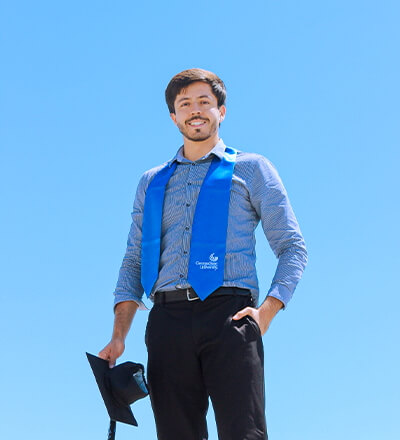 Alejandro Gorricho-Rengifo (B.B.A. ’23), who is pursuing a dual MBA and Master of Science in Data Science & Analytics, has applied his passion for engineering in his courses and beyond — from winning first place in artificial intelligence (AI) competitions to using machine learning technology to predict the future FIFA World Cup 2026 winner. After graduating, he hopes to deepen his knowledge by managing production-level projects and pursuing a career in data engineering.
Interview by Zohra Basmadjian
Tell me a few things about yourself.
I was born in the U.S. but raised in Colombia, which gave me a broad worldview and appreciation for different cultures and histories.
I started my journey at Georgia State as a political science major before switching to economics, for which I earned my bachelor’s degree. About a year later, I entered my current program, a dual MBA and Master of Science in Data Science & Analytics.
What drew you to AI and machine learning?
My dad introduced me to artificial intelligence and machine learning. I’m naturally curious and enjoy learning about science, history and engineering, especially through hands-on work.
Can you describe some of your work?
I competed in a generative AI engineering competition for the Technology Association of Georgia. I participated in their annual competition, where schools and companies showcase their data analysis and engineering skills.
Our team won first place because of my research, engagement with the client’s needs, and the data analysis and a chatbot we created. I like facing a problem head-on, getting hands on and using both my mind and my skills, which helped our team win first place.
Can you tell me more about your bachelor’s experience and your master’s experiences, and how those differ?
My first year of undergrad was online due to the pandemic. I balanced full-time classes with a restaurant job to support myself, while earning good grades and making the dean’s and president’s lists.
My master’s program is similar in workload but more flexible, allowing me to study on my own time. The program is convenient for students balancing work, study or internships.
What roles or opportunities are you interested in pursuing after graduating?
With AI transforming the workplace, I’m preparing for data engineering roles and learning to manage production-level projects.
Is there a personal project you want to work on?
I want to participate in more competitions. In class, I built a machine learning binary random forest classifier model that predicts which teams have the highest potential to win the next World Cup. Building this tool helped me grasp AI fundamentals. I like learning the basics of how AI operates, classifies and predicts. I believe a strong foundation is key to advancing in AI.
Currently, I’m working on a project with Azure, combining data engineering and machine learning.
How do you give back to your community?
I work as a substitute bus transportation assistant with neurodivergent students and those with behavioral or physical challenges. I also won a charity competition focused on kids with social issues and want to use predictive analytics to support organizations that serve them.
Why is helping other people important to you?
As someone who is neurodivergent, I relate to these experiences. Growing up, I volunteered in my community, supported the elderly and under-resourced, advocated for persecuted Christians and helped maintain a senior home.
What drives you?
I’m driven by curiosity and a desire to use knowledge productively. My program helps me develop expertise in managing and applying AI in business.