
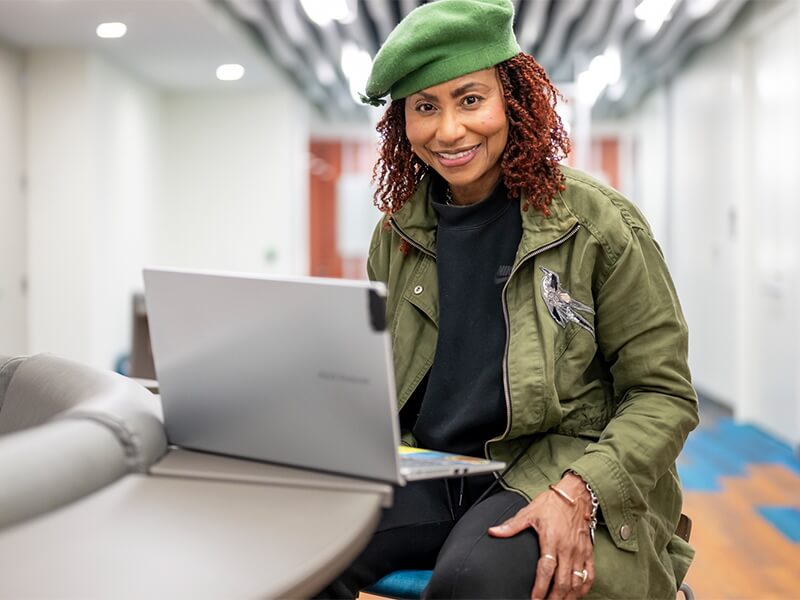
ATLANTA — When she retired after more than 20 years of running a nonprofit early learning and after-school program, Lydia Meredith (M.P.P. ’13, Ph.D. ’25) took a couple of years to rest. But before long, she realized she wasn’t done telling her story.
The author of a 2016 memoir entitled “The Gay Preacher’s Wife: How My Gay Husband Deconstructed My Life & Reconstructed My Faith,” published by a Simon & Schuster imprint, Meredith, 73, laid bare the details of a 30-year marriage she and her husband had tried to make work.
A native of Macon, Ga., Meredith earned two degrees from Vanderbilt University in the 1970s before embarking on a career as an engineer, first for U.S. Steel in Birmingham, Ala., then for Southern Co. and later for Pacific Gas & Electric, a position she landed when her husband Dennis enrolled in seminary in San Francisco.
After a decade in California, the couple returned to Atlanta to plant a new ministry, Tabernacle Baptist Church on Boulevard, in the Old Fourth Ward neighborhood. While the marriage ended in divorce in 2008, the couple had three sons and established deep roots in Atlanta.
While working to better understand both her faith and her ex-husband’s identity, Meredith completed a master’s degree in Christian education in 2009 at the Interdenominational Theological Center. To help her better understand the ins and outs of nonprofit management, such as grant writing and corporate governance, she completed a Master of Public Policy at the Andrew Young School of Policy Studies in 2013.
Turning her grant-writing chops toward telling her own story, Meredith published “The Gay Preacher’s Wife,” which has since become the basis for the premier episode of the Oprah Winfrey Network show “Unlocked: Family Secrets.” The episode, posted to YouTube in October, had nearly 1 million views as of early December.
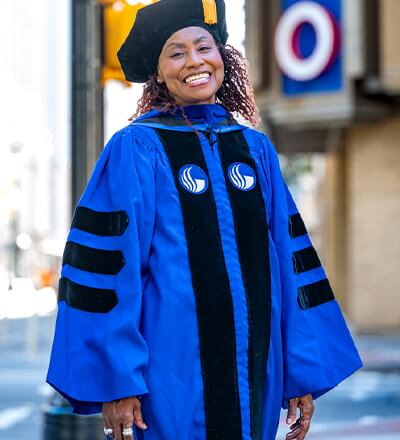 Two years into retirement, Meredith decided to pursue her latest degree, this time in rhetoric and composition.
“I woke up at 3 o’clock one morning feeling compelled to go back to school,” she said. With a clarity that felt like a calling, she said, she resolved to return and devote her writing to advancing social justice.
“That, to me, is the true work of rhetoric and composition,” Meredith said.
When she approached Georgia State about enrolling in an English Ph.D. program, she learned about GSU 62, which provides a tuition waiver to those 62 years and older. She also began working as a graduate teaching assistant, a position she’s held the past six years, leading lower-level rhetoric and composition courses and a business writing class.
She was not new to leading classes, nor to conveying the social justice imperative.
“I’ve been teaching Sunday school since I was 7 years old,” Meredith said. “My first lecture in every class is, regardless of what career you choose, you do the best you can to improve life for yourself, your family and your community.”
Having successfully defended her dissertation, “Religious Rhetoric and Rhetorical Theories of Human Engagement and Education: Mitigating Discriminatory Sentiment Against Sexual Minorities,” Meredith will participate in Georgia State’s Ph.D. hooding ceremony Dec. 15 at the Rialto Center for the Arts.
Distinguished University Professor of English Lynée Lewis Gaillet, who served as Meredith’s dissertation director, called her a “motivated and impressive scholar” who both embodies her research interests and enacts her personal beliefs at every turn.
“‘Researcher positionality’ is not an abstract term for Lydia but rather the ethical force behind her commitment to subject matter and investigative principles alike,” Gaillet said. “I’ve enjoyed learning from her.”
With her degree complete, Meredith is hoping to stay on at Georgia State as an adjunct professor while beginning work on the follow-up to her 2016 book and helping her three sons in their own local ministries.
“I’ve had so many people ask me about what’s happened since my book came out,” she said. “I cannot wait to get back to writing about my life.”