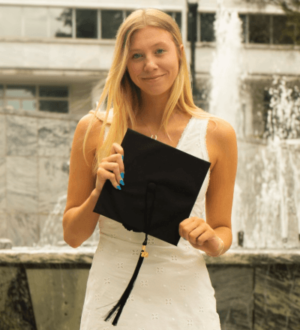
Anna Jarrell
 Senior geosciences major Anna Jarrell plans to put her education in and enthusiasm for map-making to work in pursuit of environmental equality. Below, she shares how Georgia State and its professors opened her eyes to the resource imbalance faced by communities of color.
Interview by Jordan Ferguson
How did you choose to attend Georgia State?
I don’t have the most linear schooling path. I started my undergraduate studies in 2018 at Georgia College & State University. The next thing I knew, COVID happened, and I dropped out because I couldn’t live with online schooling. It wasn’t conducive for me. In fall 2020, I joined AmeriCorps’ NCCC FEMA Corps and did a service year. I graduated from that in spring 2022. When I was done, I thought to myself, “I should probably go back to school and finish my degree.” My parents still live in Atlanta, and Georgia State is an excellent option. My dad and brothers received their master’s degrees from here, and I thought, “Let me check out the campus and see if I love it,” and I did. I transferred in the summer of 2022 and I’ve been thriving ever since.
Tell us why you chose geosciences and a certificate in geographic information systems as your career path.
I wasn’t familiar with GIS until I completed my service program. I was working with FEMA, and we were in Louisiana after Hurricane Ida. Part of our role was going door to door, post-hurricane, and using an application for ArcGIS called Survey 123. You use it to mark every home you’ve been to so that FEMA can keep track. I started looking at the maps and thought it was cool. I’ve always had an affinity for maps and told people I have a perfect geographic memory. Once I’ve been somewhere, I can always find my way back.
Then, when we went to our next round, it was a planning project for FEMA Region Seven. We were headquartered in Kansas City and creating a disaster and hazard plan. My role and my teammate’s role was putting together profiles of all the cities in a central metropolitan statistical area in FEMA Region Seven. We had to request maps from the GIS people. I thought, “Oh, the GIS people make these maps, too.” I was intrigued. If I hadn’t done my service program, I would not have found it, and it was just kind of a serendipitous moment.
What’s your goal after graduation?
I eventually want to earn a master’s, but I want real-world experience first and a break from school. In the meantime, I have been looking toward sustainable and equitable urban development. I would like to work on a local-government level. I loved my time with the FEMA Corps, and I truly enjoyed being able to have an impact on people. I want a role where I can work with people and problem-solve for others. The ultimate goal is that whatever position I find where I’m using GIS as my main application, I would like to do it in a way that serves my community.
What has been your most impactful class thus far?
One of my favorite classes that I’ve taken, and I tell everybody this — I’m like, “You need to take this class” — is Urban Geography with Katherine Hankins. It’s so fascinating. It’s the class that got me into the idea of urban development. We got to go on four walking tours of the metro Atlanta area during the semester. It’s a fantastic way to situate what you’re learning and where you live.
Another favorite was Environmental Justice with Richard Milligan. This class was impactful because, in downtown Atlanta, there is a detailed history of redlining. Learning and understanding the impacts of environmental racism and the impacts that people of color and people in lower economic classes have felt in Atlanta was another reason that I want to work in a capacity where I can address those issues and bring equity into environmental discussions.
How is Georgia State helping you achieve your goal?
First and foremost, I have an internship through Georgia State with the South River Watershed Alliance (SRWA). One of my goals was to gain some lab experience because that was one area of my education that I was lacking, but it also gave me a chance to have a meaningful impact. I’m a water quality monitoring intern for the SRWA, which means every two weeks I go out and collect samples from different rivers and creeks that are part of the South River Watershed. Then, I bring them back to the lab at Georgia State, test them for E. coli levels so the alliance can keep track of all that, and then report it to the city if we identify abnormally high E. coli levels.
Without Georgia State, I would not have had this opportunity because I found out about it through Georgia State professors. They’re a big part of this internship role.