
Media Contact
Laura Deupree
Senior Director, Marketing and Communications
Andrew Young School of Policy Studies
[email protected]
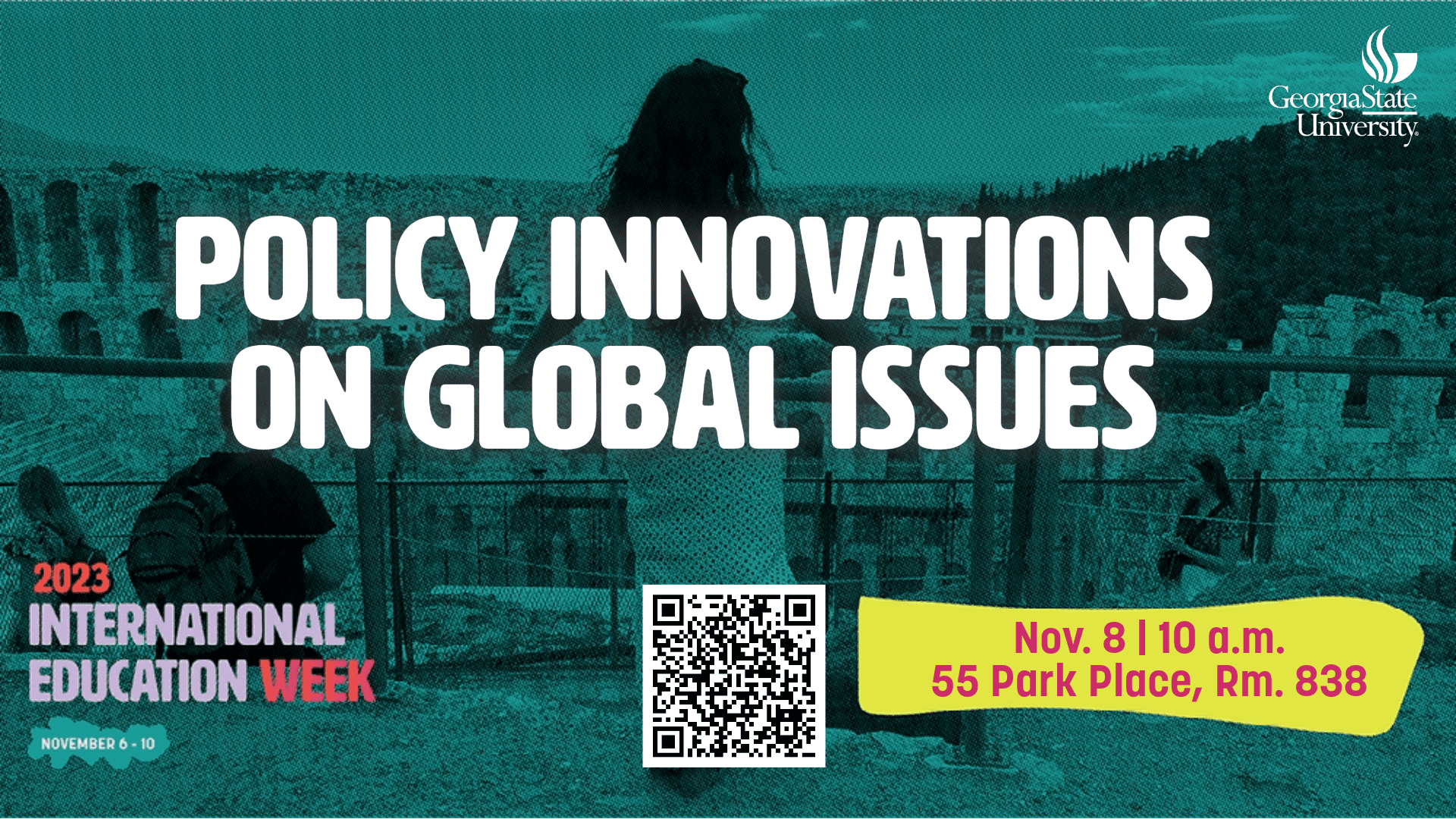
ATLANTA — Four graduate students studying in the Andrew Young School of Policy Studies (AYSPS) will lead the International Education Week (IEW) panel discussion “Policy Innovations on Global Issues.”
The discussion will take place Nov. 8 from 10 to 11 a.m., at 55 Park Place NE, Atlanta, in Room 838.
Jung Won “Leo” Choi, Kyela Gadi, Jiajing “Scarlette” Shi and Hsin-Ta “Andre” Tsai, each from different parts of the globe, share common experiences as they work to complete their Ph.D.s in public policy at Georgia State. Their research and policy interests, however, are varied and complex, giving them much to contribute to students who attend the IEW panel program.
“International students play a vital role in fostering a global perspective within our academic institution, enriching the discourse with diverse experiences and insights,” said Esra Tanyildiz, a clinical assistant professor in the Department of Public Management and Policy in AYSPS who organized the panel.
“Their presence not only enhances the cultural diversity of the student body, but also empowers students to establish connections that can bridge policy issues between their home countries. Through their research and observations, our doctoral students will present innovative policy solutions across borders, ultimately contributing to a more interconnected and informed global policy landscape.”
Choi was born in Korea and grew up going back and forth between the U.S. and Korea while attending K-12. He earned his undergraduate and graduate degrees in Korea. Prior to pursuing his doctoral studies, he led social impact management and international sales for a South Korean social tech startup that makes environmentally friendly bamboo toothbrushes.
Choi became interested in social innovation as an undergraduate, after his college secured a large government grant to establish a center for social innovation.
“My adviser led the center, so I got to know about a lot of social innovations around the country, like social tech startups that use business as a force for good,” he said. “I was attracted to how social enterprises were able to generate social impact without compromising financial performance. For example, the social enterprise I worked at is innovating the bamboo toothbrush manufacturing process to compete with plastic toothbrushes and not solely rely on ethical consumers. This enables them to scale social impact proportional to their financial returns.”
From his public management and policy background, Choi researches how public organizations can harness innovations by entrepreneurs to achieve public goals. He has advised the Ministry of Interior and Safety of South Korea on its efforts to leverage innovations from the private sector and the citizenry to address societal challenges, and he has written on South Korea’s social enterprise clusters.
“In innovation policy, we used to assume that government support for researchers and businesses led to a trickle-down effect that would improve everyone’s lives,” he said. “Lately, innovation policy is being re-framed around societal outcomes a government wants to achieve. Public organizations want to project their public values through partnering with actors in the private sector, and I’m interested in how to manage this relationship.”
The opportunity to work with a faculty expert in this area, Associate Professor Janelle Kerlin, brought him to Georgia State.
“Most social enterprise research comes from business schools,” Choi said. “Janelle Kerlin is one of the few who looks at it through a policy lens. She pretty much defines this field. Recently, we’ve been comparing social enterprise ecosystems across the emerging BRICS economies — Brazil, Russia, India, China and South Africa — and when I reached out, sending a cold email to scholars in South Africa and Russia, everyone said they were huge fans of Dr. Kerlin’s work. It’s a shared impression globally about her pioneering work in the field.”
The other reason he chose Georgia State? His wife Jeongyoon Yang is also in the college working on her Ph.D. in public management and social policy.
When Choi isn’t studying or hanging out with Yang, he’s training for a half marathon. He plans to continue his career in academia as an innovation and entrepreneurship policy researcher.
Gadi learned about Georgia State University when she participated in the Mandela Washington Fellowship for Young African Leaders in 2016. Recognized as a young African leader from Nigeria, she was chosen for the public management track and assigned to the University of Maine. At the end of the fellowship, she attended the Presidential Summit in Washington, D.C.
“It was such a thrill to hear President Barack Obama speak about public service and the role of young leaders,” she said. “During the summit, I met fellows who participated in the program from Clark Atlanta and GSU who shared their experiences, and I became interested in exploring policy schools in this area. Two years later, I applied to GSU, and here I am.”
In Nigeria, Gadi worked in a policy research and education nonprofit.
“Girl child education is an issue in Nigeria,” she said. “The work I did there helped keep more girls in school, and I worked with organizations and families to expand educational opportunities for girls and young Nigerians. Those work experiences propelled me to seek the doctoral program at AYSPS.”
In her research, Gadi is interested in public management, performance management and higher education research.
“I research how different policy interventions help give more students access to college,” she said. “I examine policy innovations that states in the U.S. are offering — like free tuition and performance incentives — to incentivize students to go to college and to ensure that colleges improve their performance and that students succeed.”
She also works as a research assistant in the Georgia Policy Labs.
“In this role, I’m involved in an evaluation project, led by Professor David Ribar, that assesses how technical colleges in the state of Georgia are implementing micro credentials in healthcare, information technology and manufacturing. We’re seeing how the colleges employ new technologies for instruction and create linkages between their students and employers in these occupational areas.”
When she completes her degree, Gadi plans to join academia to teach others about public policy and continue her research in higher education.
“I’d like to conduct more policy-relevant research that links what I’m doing to what policymakers and college administrators need to ensure college is affordable, and to encourage more people to go to college,” she said.
Shi majored in social work as an undergraduate in China before she came to the U.S. in 2017 to earn a master’s degree in public administration at the University of Washington, specializing in policy analysis and evaluation. She developed her interest in the healthcare environment and hospitals while doing her social work internship in a public hospital in China.
“Social workers in the hospital where I interned had very good intentions and wanted to help people, but the environment and policy issues often prevented them from getting the outcome they wanted,” Shi said. “And while a social worker aids two to three clients at a time, policy impacts a lot of people and is very efficient. That’s why I’m doing public administration and policy in my master’s program.”
As a joint doctoral student in public policy at Georgia State University and the Georgia Institute of Technology, Shi connects to the faculties at both institutions and works on several research projects in health policies and health service research. Shi also works in the Georgia Health Policy Center (GHPC) on a major project about blood disorders with Angela Snyder, GHPC’s director of health policy and financing.
“The Centers for Disease Control and Prevention (CDC) founded a program called the Sickle Cell Data Collection for Georgia,” Shi said. “We’re building a data surveillance system that collects data on the sickle cell population and are using the data to answer research questions.”
Aside from building her academic career in health policy analysis and health disparity research, Shi is also interested in examining the use of artificial intelligence (AI) in healthcare in China.
“China has unique advantages in embedding AI in real-world practices. AI has gradually been integrated into the system in China, but it is still in the testing stage in the systems here and many issues arise in the process,” she said. “It’s fascinating to see how AI technologies could be utilized to solve longstanding healthcare issues and improve healthcare outcomes for all. I want to pursue this in my future career.”
When Shi finishes her degree, she plans on remaining in academia. “I’ll continue working on projects in healthcare and healthcare systems, specifically to evaluate healthcare practices and analyze health policy,” she said. “The goal for the research I do is to provide evidence-based findings to help improve decision-making and policymaking processes.”
Tsai’s journey has taken him from a modest home in Taiwan to Berea College, in Kentucky, to the University of Oxford in the United Kingdom, to the University of Chicago, and to Georgia State University to earn a joint Ph.D. with the Georgia Institute of Technology. Early on, he developed an interest in higher education and how it can help turn lives around, especially for lower-income students.
“Berea College is unique in that it is the only college that admits mostly, if not only, low-income students, including me, and charges them no tuition,” Tsai said. “People say education is transformative — but how? I became really interested in that idea. I like to study education policies across national borders. How are these policies different from each other, with a focus on higher ed? I want to piece together a picture to better understand the magical promises of how higher ed policies, for example, help a person from a lower socioeconomic class become better.”
He went to Oxford for an education degree, taught for five years, and realized he didn’t have the policy background he desired. So, he worked to earn an M.A. at the Harris School of Public Policy at the University of Chicago.
“The Harris School made me realize that many policy schools are essentially applied microeconomics programs,” he said. “We did a lot of math and statistical foundations in economics for our core classes. I realized that could be a drawback for my one-year program, as I don’t have a lot of foundations or theories from other fields to inform my policy research.”
Tsai learned about Georgia State’s joint Ph.D. program in public policy with the Georgia Institute of Technology and moved to Atlanta to attend.
“The joint degree program combines the best of both theory and application from a technical and a state school,” he said. “I was also drawn to the Appalachian region from my undergrad experiences. I want to study how education policy makes a difference for minority populations. Georgia State is so close to this region, and we have top professors in different policy fields in this program. Our studies here are more interdisciplinary.”
Tsai plans to present on marriage equality, another major social-policy interest, during his part of the IEW panel program.
“I took two core classes with Professor Greg Lewis, whose research looks at federal employment and LGBTQ people,” he said. “The classes are interesting to me as I learned how to approach answering public policy questions regarding another marginalized group using social survey data. So, I decided to also study the social policies affecting the LGBTQ community in my country, with Professor Lewis as a co-author.”
Taiwan was the first country in Asia to legalize same-sex marriage, in 2019, and Tsai’s paper looks at public support for marriage equality in Taiwan from a social data perspective.
“We looked into the social survey data and learned that people who were leading the country at the time — like the Supreme Court and the president — thought it was time for the law to be passed,” he said. “But from 2015 to 2020, on average, we observed a trend of lessening overall support for same-sex marriage. How can we explain this decline in public support despite popular legislative and judicial support? What are some of the factors contributing to people’s support level for same-sex marriage?”
With these questions, Tsai computed what he calls the “Confucian cultural index,” an innovative measurement indicator he’s eager to share more about during his part of the presentation.
Tsai hopes to eventually be a professor focused on the economics of education and education policy.
To learn more about the panel discussion, go to https://calendar.gsu.edu/event/policy_innovations_on_global_issues.