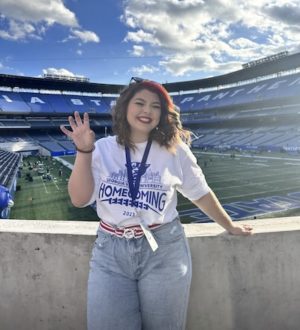
Emily Smith (A.S. ’23)

A former business owner in the wellness industry, Emily Smith (A.S. ’23) transitioned from Perimeter College to the Atlanta Campus to earn a degree in neuroscience. Now she’s navigating undergraduate classes and two neuroscience research opportunities as a Goldwater Scholar.
Interview by Jordan Ferguson
Tell me about your journey to Georgia State.
I am definitely a nontraditional student. Before the pandemic, I was living in New York City and I owned a wellness center. I taught a method of exercise called Gyrotonic. I was living my happy life. Then COVID came along, and New York was shut down. Everybody shut down businesses for six weeks, and you can’t do that when you’re a small business owner. You can’t lose income like that. I decided to close my business permanently and I relocated to Atlanta.
I started taking classes on a whim. I am generally an intellectually curious person, so I thought it would be cool to take some classes. Not long into that first semester at Perimeter I thought, “Wouldn’t it be cool if I could start to look at all the things that interest me on the practical side of the work that I’ve been doing?”
I’ve been working with people for many years in injury rehabilitation and performance conditioning, and while I primarily worked with elite athletes for the last decade of my career, I worked with all kinds of people before that. I thought it would be cool if I could start to ask questions, in an academic setting, about the observations I was making on the practical side. I ended up getting my associate degree at Perimeter College and I’m now at the Atlanta Campus getting my bachelor’s in neuroscience.
Why study neuroscience?
I realized I wasn’t going to get to ask the kinds of questions I wanted to ask in kinesiology. I signed up with kinesiology as my initial interest, but once I got into the classes I realized kinesiology is more rooted in the practical stuff. I’d had 20 years of the practical stuff, and I wanted a different perspective.
The Gyrotonic method is a specific method of exercise. It’s in the mind-and-body family. It’s becoming popular in conversations around neural plasticity and functional movement training that incorporates what we know from neuroscience and tries to engage the brain and the body at the same time for better results. I’ve been doing that for many years and now I’m getting to study what’s actually happening in the body and the academic perspective on it.
Are you working with any research labs?
I’m working with two labs, one of which is based out of the Atlanta VA Medical Center, where I’m working with Lisa Krishnamurthy. She is affiliated with Georgia State through the TReNDS Center. We are looking at how exercise impacts a specific neurotransmitter in the brain, specifically in stroke patients. What we’re finding is that if you do some high-intensity training, you can see changes in the primary inhibitory neurotransmitter of the brain. This neurotransmitter has been associated with learning and memory. We’re getting ready to start a three-month trial of exercise to see how that impacts the brain.
I am also working with Gennady Cymbalyuk at the neuroscience lab on campus. There, I’m looking at computational models. We use computational methods to evaluate the behavior of different circuits in the body. Right now, I’m working on a mammalian spinal circuit and seeing how it behaves computationally.
I’m participating in both research projects because I’ve decided I want to go to graduate school and pursue a Ph.D. in biomedical engineering. I hope to focus on neuromechanics, which is how the nervous system controls movement.
How is Georgia State helping you realize your dream?
I am grateful for my experience at Georgia State. I think the commitment to undergraduate teaching is so clear. The more you’re willing to engage with a subject, the more opportunity and support you’ll receive from the people around you — from your professors to organizations like CASA (Center for the Advancement of Students and Alumni).
CASA, as an organization, is really committed to finding research opportunities for undergraduates, and they’ve now connected me with three different labs so that I could get a wide variety of experience. It’s given me more confidence to transition from being a small business owner to being in an academic setting. So much of what I know about movement and the body is from experience, but sometimes that isn’t valued as much in academic spaces. That’s never been the case for me at Georgia State.
How did it feel when you found out you won the prestigious Goldwater Scholarship?
I couldn’t really process it. It was overwhelming, to say the least. I’ve worked really hard for a long time, and as a business owner, you don’t get any pats on the back or encouragement. The sign that you’re doing a good job is that you get to keep doing your job the next day. It was validating to know that taking this chance to step away from making a living and put myself on this different trajectory was all worth it. That was very meaningful.
What advice might you have for students at Perimeter College looking to transition to the Atlanta Campus?
I would first say to them that they’re going to be really well prepared, so don’t worry about that. At Perimeter, it was easier for me to find a community of people because the classes were small.
I would encourage people who are going to transition downtown to start connecting with other people who are going to be going downtown so that maybe they’ll have a friendly face when they get there. I would look into maybe joining a club or a research lab where you can find that sense of community, because I think that’s really important during school. I think it helps you succeed.