
Media Contact
Amanda Head
Manager, Marketing and Public Relations
College of Arts & Sciences
[email protected]
Matthew Nelson (M.A. ’15, Applied Linguistics & ESL) now works as an English Language Fellow for the U.S. Department of State in Pokhara, Nepal. Through this fellowship, Nelson works closely with the U.S. Embassy in Kathmandu to improve English-language learning throughout the Himalayan region.
We were able to catch up with Nelson in Nepal, and he answered the following questions for us.
Please tell me a little about what it is like being a Department of State English Language Fellow.
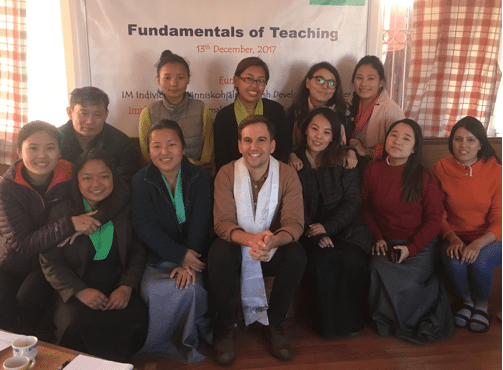
As an English Language Fellow in Nepal, I have a variety of different duties. At the university, I teach classes in the Department of English Education. I teach “English for Communication” courses to undergraduates and “English Language Methodology” courses for graduate students. I also conduct teacher-training workshops for English-language teachers all across Nepal. I have traveled to remote areas of Nepal to conduct workshops on topics such as “Communicative Grammar Teaching,” “Digital Storytelling,” and “Integrating Language and Content Instruction.” Finally, I have carried out a number of “secondary projects,” which are self-designed educational projects, driven by my personal interests and expertise, conducted in collaboration with local institutions. For example, in Pokhara, I have taught courses on documentary filmmaking, creative coding, and electronic music production.
How did studying ESL at Georgia State help prepare you for your work in Nepal?
The program in Applied Linguistics and ESL provided me with a lot of practical knowledge related to language-teaching methodology that has been extremely useful for my work in Nepal. The praxis-oriented approach of my program at Georgia State gave me a lot of experience in designing language lessons, activities and curricula. Additionally, my professors at Georgia State encouraged me to be a critical, self-reflective educator, which I think is especially important when working as an English-language teaching professional in an international context.
If you had to name one thing you liked most about Georgia State, what would it be?
The faculty in the Department of Applied Linguistics & ESL was amazing. They are some of the top experts in the field, yet still very down-to-earth, approachable, and very invested in the success of their students. Overall, there was an amazing community within the department among students and professors.
Who was your favorite professor at Georgia State and why?
Stephanie Lindemann, who teaches sociolinguistics and phonetics in the Department of Applied Linguistics & ESL. She helped open my eyes to issues of ideology, power, and inequality in language use, language teaching, and attitudes towards language. In her classes, I learned how to view myself and my work through a critical lens, which I think is vital to being a responsible and effective educator. And although the subject matter of her courses was intellectually demanding, it was also fun! I greatly appreciate her sense of humor and passion for language and linguistics.
What made you want to get involved with this type of work?
Like many English-language teachers, I was first attracted to this line of work by my interest in other cultures and languages. As an undergraduate, I studied Russian, and my first teaching job was as a Fulbright English Teaching Assistant in Russia. At that time, teaching was a way for me to travel and experience other parts of the world. Later, after returning to the United States, I continued teaching English because I loved working with students from all over the world. I have had the opportunity to teach students from so many different countries and cultures, and have learned so much in the process. I think most ESL teachers in the United States will agree that we get to work with the most interesting and inspiring students anywhere.
What is your favorite part of your fellowship?
One of my favorite parts of the fellowship experience has been the amount of variety in my professional activities - no two days are the same. I feel very fortunate to have the flexibility to carry out projects based on my own interests and expertise, as well as the needs and interests of the students and teachers I meet. I am very lucky to work in a community where there are educational institutions that are open to collaboration, and where there are so many motivated teachers who want to take part in innovative programs. None of it would be possible without them.