
For former ballerina Noa Erlitzki, Georgia State’s Chemistry Department was love at first sight
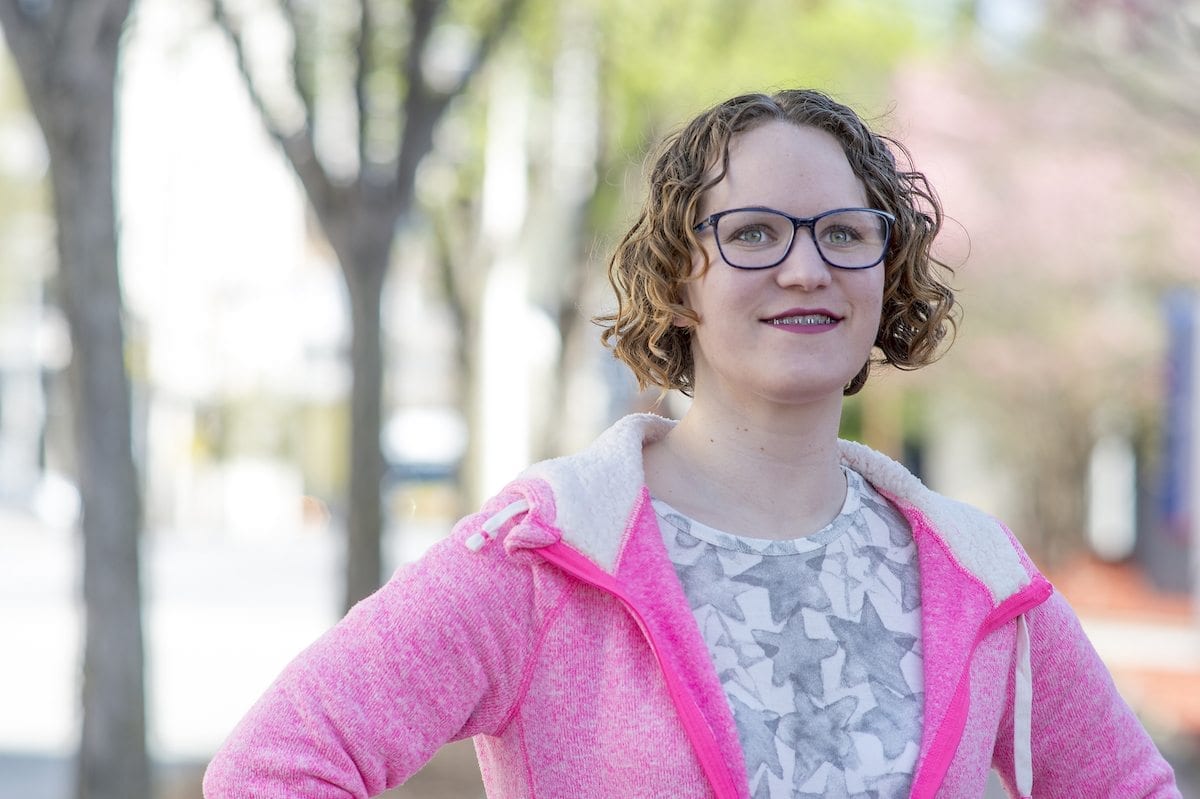 Noa Erlitzki isn’t a wizard, but she does possess an uncanny power to make things happen. When ballet struck her pre-teen fancy, Noa transformed herself into a semi-professional dancer. When she aspired to speak fluent Russian, she taught herself. And when the Barry M. Goldwater scholarship caught her eye, she claimed it.
But achievements like Noa’s can’t be willed with the snap of a finger. They demand hours and years of dedication. That grade of grit isn’t surprising given Noa’s pursuit of a dual degree in chemistry (B.S. ’17, M.S. ‘18) at Georgia State.
A native of Haifa, Israel, Noa and her family moved to Alpharetta, Ga., when she was 11 — the same year she discovered ballet. The immediate dream of dancing professionally became Noa’s whole world. And naysayers’ dismissal of her as "too old" never phased her.
When she graduated high school and researched universities, Noa sought a school that had two things: competitive academics and flexible offerings conducive to her rigorous dance schedule. The Honors College at Georgia State — and the Centennial Merit Scholarship it offered her — clinched the deal.
Noa began her studies at Georgia State part time, weaving in two six-month training stints at the Perm State Ballet School, one of Russia’s top-three ballet academies. She stood apart as the first Israeli student to be admitted.
Then, after battling an illness during her second tour at Perm, Noa returned to Georgia State and made a life-altering decision: She’d put up her pointe shoes, bid adieu to the strict diet and discipline dance demanded and focus fully on college.
"Ballet wasn’t making me as happy as it used to, and that was weird to admit to myself," said Noa.
As she adjusted to post-ballet college life, Noa shuffled between a few majors, contemplating business and nutrition. But after her first general chemistry class at Georgia State, something clicked.
"I thought I would hate chemistry," she said. "But it blew my mind! I understood it, and I wanted to learn more."
Noa couldn’t get enough. Even with her added responsibilities working in three labs, she wanted more. She’d heard that undergraduates could help with research in university labs, and while the work sounded interesting, Noa’s initial incentive was to pad her future medical school applications.
When Noa received an out-of-the-blue call from Dr. Gregory Poon, an associate professor in the Chemistry Department, to meet about a research opportunity, everything changed. Poon charged her with a special project in which she’d search for peptides capable of activating transcription factors (simply put: proteins that bind to DNA and make things happen). Like Noa, Dr. Poon was unfamiliar with the methodology required, so it would be a completely novel experience for them both. Noa recognized the gravity of the opportunity, but she didn’t expect to fall in love with research.
"There’s something about being the only one who has responsibility over something and having someone depend on you to get the data. It’s really motivating," Noa said.
As Noa established herself further in the Chemistry Department and as an integral part of Professor Poon’s lab, her focus shifted to the biophysical chemistry behind DNA and compound interactions. And she challenged herself to one of the field’s biggest feats: becoming a Barry M. Goldwater Scholar.
"It’s a really big deal!" Poon exclaimed when Noa informed him of her Goldwater intentions.
But she called on the persistence that had always propelled her.
Noa received an honorable mention, but she wasn’t satisfied. She decided to apply again, knowing she’d need to find an edge to differentiate herself from her initial application. She had been working on a first-author manuscript, and though it was in the bare-bones phase, Noa felt it was her ticket to the scholarship. She worked furiously between mid-October and late December to complete and submit it. In the end, her paper was accepted to a special-edition publication for osmotic pressure. The best part? She was finally named a Goldwater Scholar.
"I gave everything to that paper, and it was worth it in the end," she said.
Later this month, Noa will attend her third and final Georgia State Undergraduate Research Conference, where she earned first place in the poster presentation and nabbed a Provost Award for the Natural Sciences category. This year, she’ll present on the electrostatic and hydration properties of DNA minor groove-binding by a hectercyclic diamidine by osmotic pressure.
Perhaps she'll relax after that – well, after she masters the piano, that is.
Photo by Steve Thackston
Check out some more of our most amazing students.
-
 Nia Mitchell is a Presidential Scholar with a pre-med concentration. She’s studying obesity in Dr. Aaron Roseberry’s neurobiology lab. Her research considers how fasting affects the body’s need for different macromolecules such as protein, fat and carbohydrates.
-
Pranathi Venigandla, a computer science major, is fascinated by robotics and artificial intelligence. Her research revolves around a Remotely Operated Vehicle robot, which enables underwater exploration. As the lead director of hackGSU and a member of Girls++, Pranathi is determined to expand women’s place in the technology space.
-
On his path to becoming a symphony musician, Sam Crowley has studied multiple instruments, including trombone, double bass and piano, and interviewed notable musicians round the nation. That background aids his research into how to be a versatile and successful musician.