
Media Contact
Amanda Head
Manager, Marketing and Public Relations
College of Arts & Sciences
[email protected]
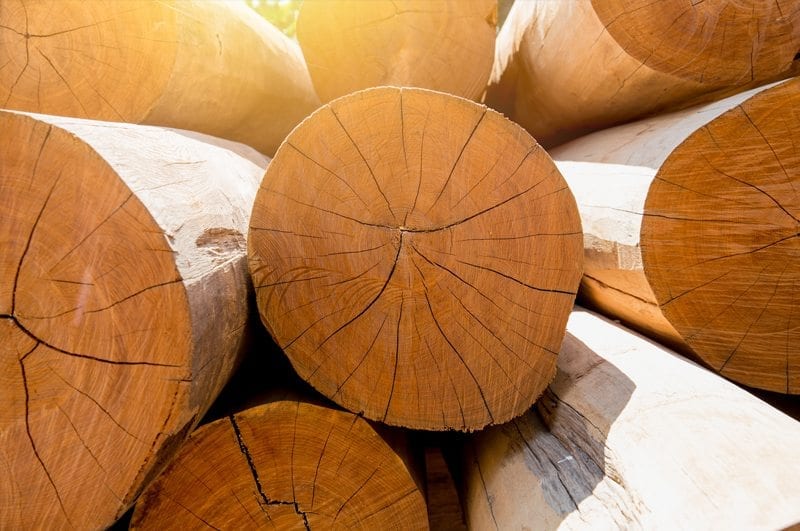
Between 15 and 30 percent of all wood sold worldwide is harvested illegally, according to Interpol.
Some comes from endangered species. Some from species that are being harvested faster than they can grow back – which is to say, they are on the road to becoming endangered. And some sustainably grown trees are part of habitats for other endangered species.
One Georgia State undergraduate is trying to fix the problem. Caroline Johnson, a senior computer science major, is working on a program that can identify a piece of lumber – and therefore tell if it’s legal to sell.
Johnson’s preliminary work is so impressive that she won a “best poster” award at GA Statistics Day, an annual data science conference. She beat out graduate students from Emory, the University of Georgia and Georgia Tech to win the award.
Her program, which is built using machine-learning tools, can identify wood samples accurately 85 percent of the time. She and her advisor, Assistant Professor Daniel Pimentel-Alarcon, think they can improve that rate – they’re spending the spring semester building neural-network techniques into the project.
Johnson started her work with an existing database: 103,000 wood samples in a collection managed by the United States Department of Agriculture and the University of Wisconsin-Madison.
She then built an algorithm that measured the defining characteristics of each sample – the size and shape of the wood grain, and the orientation of the fibers in the wood, among others.
“You can take a picture of wood at an importation hub,” Johnson said, “and use my algorithm to identify it.” The pictures would be taken with a XyloTron, a hand-held field microscope.
Johnson said the project opened her mind to the ways that computer scientists solve real-world problems. She had intended to go into industry after graduation, but her research experience changed her mind, and she is now applying to graduate programs.
That’s not uncommon among undergraduates who do research, said Pimentel-Alarcon. In classes, students work on problems that already have an answer. But in research, students are working on problems that have never been solved before.
“It opens their minds to not knowing stuff,” he said. More than that, it introduces them to the bigger picture that lies behind coding – a bigger picture that improves their career prospects.
“Computer science is not just programming any more,” Pimentel-Alarcon said. “It’s more and more a data science field.”